Sift
Scattered customer feedback becomes a prioritized roadmap, and every item on it can be traced back to the people who said it.
- My role
- Product design end to end: research, jobs, journey, architecture, prototype, voice, concept
- Primary user
- Product Manager at a 50 to 500 person B2B SaaS
- Built
- 17 screens, 39 pages, 10 clusters, every state its own page
- Stage
- 7 of 12 stages complete, through Concept
The market solved collection. Nobody solved defence.
A product manager at a mid-market B2B SaaS has feedback in Intercom, in Zendesk, in Gong call recordings, in review sites and in a folder of interview notes. There is no shortage of tools that gather it. The moment that hurts arrives later, in the room: a stakeholder asks why this is on the roadmap and not that, and the honest answer is a feeling.
I scored six candidate jobs on frequency, intensity and willingness to pay. Two tied at the top, and they were not the ones the category advertises: synthesize scattered feedback quickly and defend a roadmap decision with evidence. Staying on top of incoming feedback, which is what most competitors sell, scored 4 out of 10.
So the product is not a feedback collector with better summaries. It is an instrument for making a call you can survive being challenged on.
Skeptical of the thing the product is built on.
The primary user is a mid to senior PM, three to eight years in, comfortable with data but not an analyst. The finding that reshaped the whole design was about trust: this user does not believe AI synthesis, and will not trust a tool that gives a confident answer without showing its work.
That is an awkward position for a product whose engine is AI synthesis. It means the summary is not the value. The summary is the claim, and the product only earns anything if the claim can be opened, inspected and challenged, live, in the meeting where it is being questioned.
It does not win by summarising better. It wins by being challengeable.
The trust chain is the information architecture.
Everything downstream is arranged around one path: from a ranked theme, to the evidence items behind it, to the raw customer sentence in its original context. Seven entities, ten clusters, thirty-nine specified nodes. Three global navigation entries instead of five, because a tool that argues for calm under density cannot open with a wall of tabs.
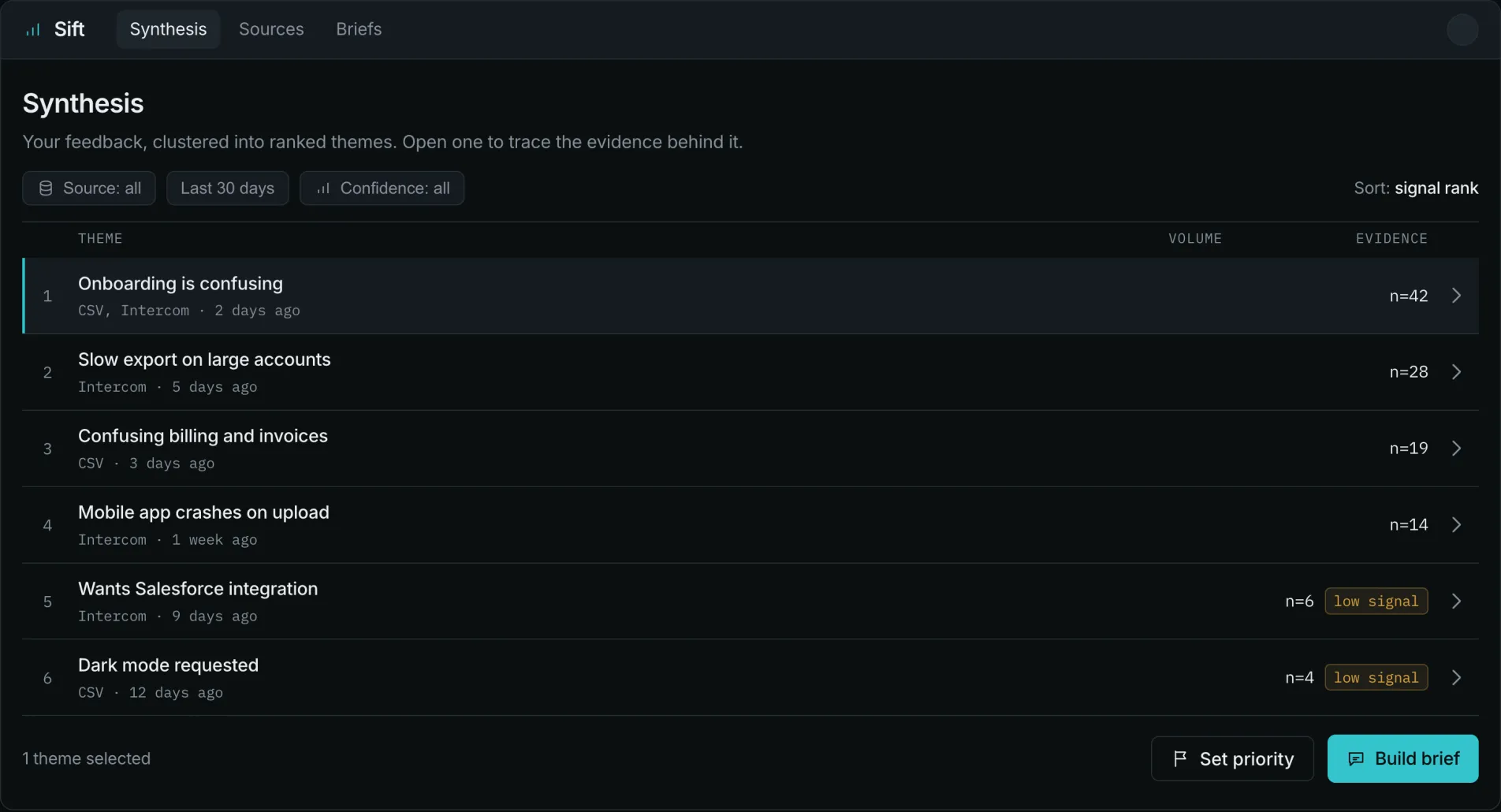
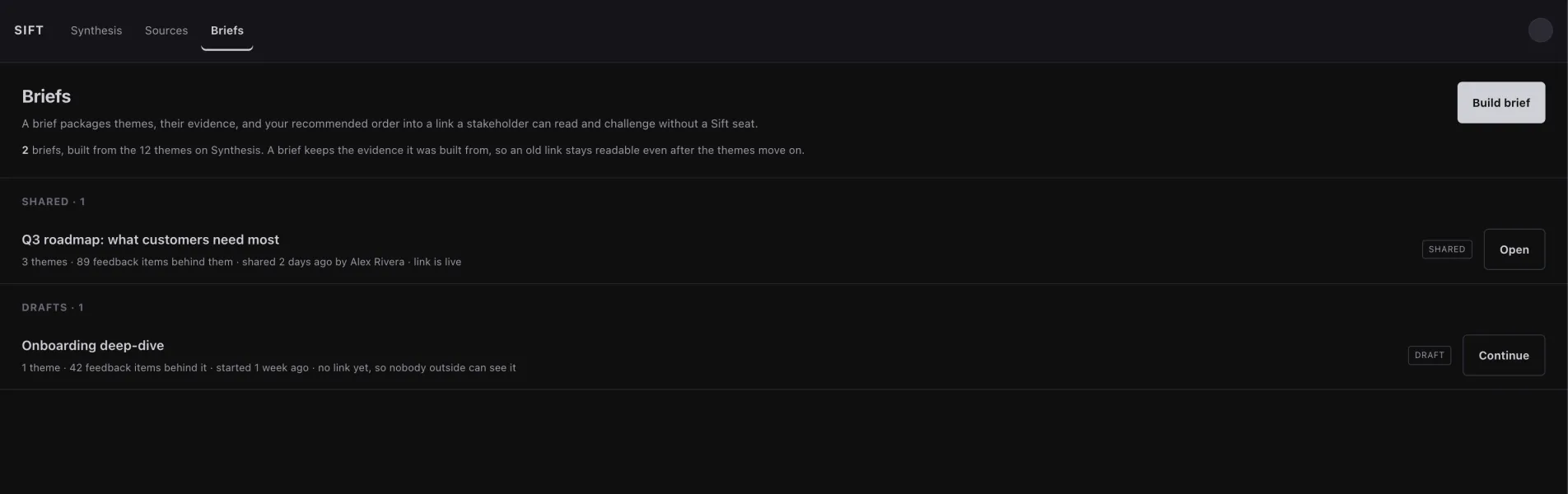
The ranked picture sits at tap zero: Synthesis is the app home, not a dashboard you navigate to. The full chain down to raw evidence is two taps. Capturing the defensible call as a shareable brief is one.
The chain, as the product renders it.
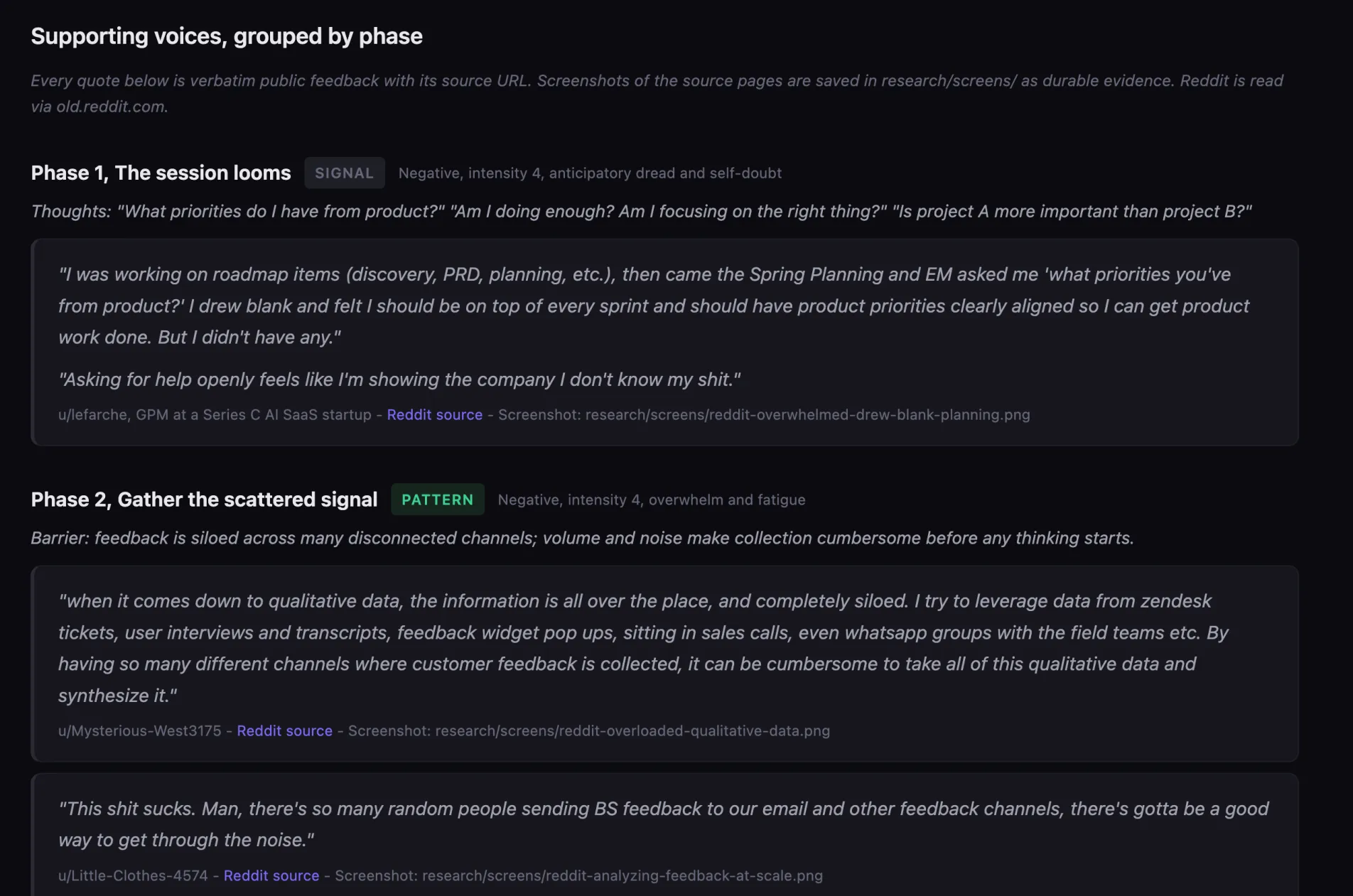
Two screens from the deployed product and one page from the research under it. They are the two ends of the same claim: the ranked picture a Product Manager acts on, and the public sentences it was built from, each with the URL it came from.
Three calls that closed arguments instead of opening them.
Confidence display ships on day one, not in v2.
Every theme carries its item count, and thin evidence gets a low signal badge. This is normally a polish item. Here it is the condition the riskiest assumption rests on: if the user cannot tell a strong theme from a thin one at a glance, the transparency promise is decoration and the product has no reason to be trusted.
CSV before integrations.
CSV is the zero-friction activation path: a PM can be inside the product with their own data on day one, without asking anyone for admin access. Intercom is the first named live source, and Zendesk and Gong ride the same abstraction rather than each becoming a project.
One job is deliberately not built, and it is written down.
Closing the loop back to the customer who gave the feedback is a real job for a secondary segment. It has no MVP screen by design. It sits in the trace matrix as a deferral with a reason, so the next person to read the architecture sees a decision rather than a hole.
What this file does not know yet.
[?] Does transparency actually buy trust. The whole product is a bet that a PM will trust a synthesis they can open and challenge. That is the riskiest assumption, and no amount of design closes it. It closes in a prototype test with real PMs and their own data.
[?] How much time this actually saves. The value story rests on hours of manual reading and tagging. The order of magnitude is defensible; the exact figure is not yet, and it is carried as an open question rather than rounded into a marketing number.
The real files, not a retrospective.
Everything below is the working artifact, published as it was made, including the critique logs.
Tendd