Product and business thinking
I score the jobs before anything gets built. I argue funnels, retention loops and pricing gates in writing, then defend them. I arrive with an opinion about what the business needs, not a list of screens to draw.
I design products end to end and build them in code. Every screen traces back to a decision, every decision back to evidence, and anything still unproven is marked [?] rather than smoothed over.
I score the jobs before anything gets built. I argue funnels, retention loops and pricing gates in writing, then defend them. I arrive with an opinion about what the business needs, not a list of screens to draw.
Entities, flows, sitemap, then a written spec for every page and every state. Nothing appears for the first time inside a wireframe. A prototype renders a finished structure; it does not invent one.
I build the thing. Responsive prototypes, design systems and production HTML, CSS and JavaScript, shipped from my own machine at the speed the decision was made. This page is one of them.
Twelve stages, run in order, on every product. Each one leaves a written source of truth and a defect log behind it. Slower to start. Far faster to finish, and much harder to argue with.
Turns scattered customer feedback into prioritized product decisions, where every roadmap item stays traceable to the real user voices behind it.
7 of 12 stages · through concept Case study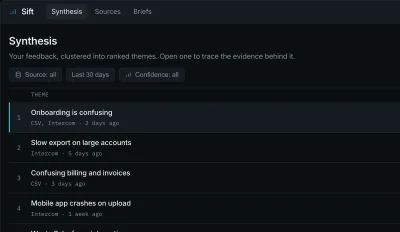
Helps people who avoid their finances see and cut recurring payments, by replacing the wall of numbers with a reveal they can survive.
11 of 12 stages · through responsive and motion Case study
Runs real wellbeing programs for companies with no HR team, and proves it is working at team level without ever surveilling one person.
6 of 12 stages · through voice Case study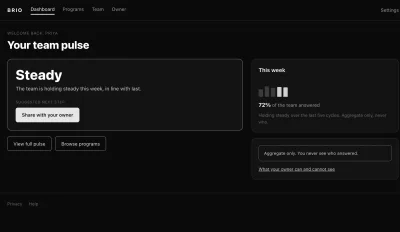
A hole found while building a wireframe is not patched in the wireframe. It is fixed in the architecture, then rendered again. That single rule is why the visual stage is fast: by the time colour lands, there is nothing left to decide except how it should feel.
When I do not know something, I write it as [?] and carry it forward with the test that would close it. An unmarked guess is the most expensive object in a design file: it looks like a decision, it gets built like a decision, and it is only found once the product is live.

I have been designing digital products for more than ten years. Most of that time was spent inside one large B2C platform built on complex game mechanics, retention loops and reward systems: the kind of product where changing a single progression rule moves the behaviour of the entire user base, and where you learn that a screen is never the unit of work.
That taught me to design systems and to expect every decision to be argued in numbers. What I do now is the same discipline, run in the open and end to end: take a product from the first research question through to a working interface, and write down why at every step. The case studies here are not retrospectives written after the fact. They are the actual artifacts, with the defect logs and the open questions still in them.
I work fastest with teams that want an owner rather than a supplier: someone who will argue about the business model on Monday, restructure the information architecture on Wednesday, and have it running in a browser by Friday.
I am a team player who is comfortable owning the decision. The design happens inside a team: thinking shared early, critique taken straight, the craft bar raised with the people around me rather than above them. When a call has to be made, I make it and stand behind it. This far in, the work I still want is the design itself: the research, the architecture, the interface and the code. That is why the seat I am looking for is an individual contributor one.
If you are hiring for a senior product design role, or you have a product that needs to be taken apart and rebuilt, tell me what it is and what is going wrong. A rough description is enough. I will tell you whether I am the right person for it.